
Article Sidebar
Main Article Content
 Knowledge base
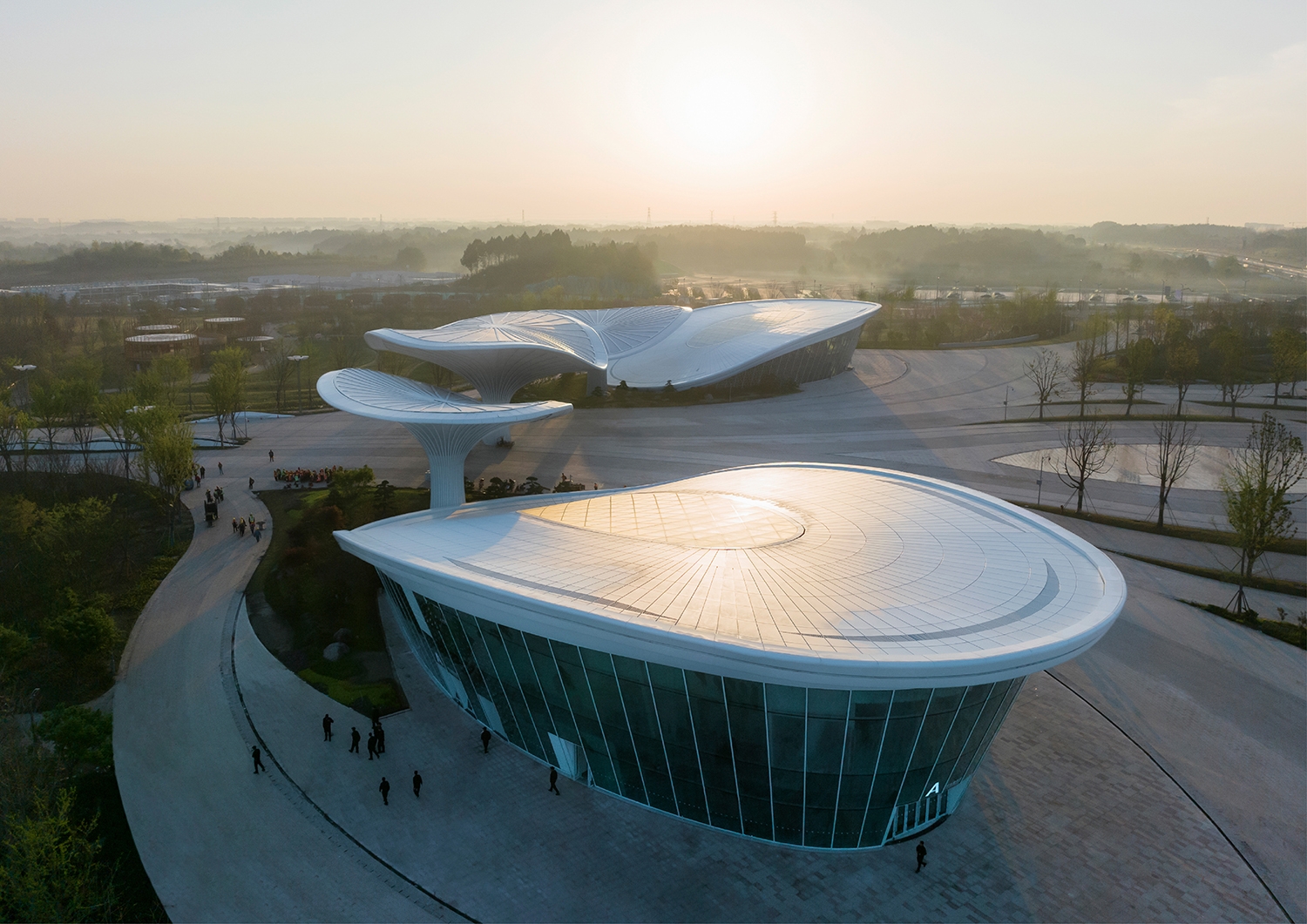
Humanity has learned fundamental principles from nature, understanding which has enabled the creation of numerous inventions, such as the parachute and helicopter, as well as numerous optimisations, such as the aerodynamic shape of the Japanese high-speed train (Shinkansen). Plants, in addition to their morphological characteristics, possess a remarkable ability to adapt to environmental changes. Biomimicry architecture draws inspiration and processes from nature, utilising these principles to optimise design, improve energy efficiency, and dynamically respond to the environment. The study was conducted using purposive sampling on three Chinese projects: Lotus Building in Changzhou, Pearl River Tower in Guangzhou, and Comprehensive Service Pavilion of the 2024 Chengdu International Horticultural Expo, which were selected according to Pohl and Nachtigall’s classification. The analysis indicates that natural inspiration can occur at three levels of transfer: formal inspiration, process mapping, and implementation of adaptive strategies. Case studies show the gradual transition of biomimetics applications from symbolic formal inspiration to advanced strategies responding to climate changes. Biomimetic architecture, combined with parametric design and interdisciplinary design, has the potential to deliver innovative solutions to achieve international climate neutrality goals.
Article Details
AlAli, M., Mattar, Y., Alzaim, M., & Beheiry, S. (2023). Applications of Biomimicry in Architecture, Construction and Civil Engineering. Biomimetics, 8(2), 202. https://doi.org/10.3390/biomimetics8020202 (Crossref)
Amer, N. (2019). Biomimetic Approach in Architectural Education: Case study of ‘Biomimicry in Architecture’ Course. Ain Shams Engineering Journal, 10(3), 499–506. https://doi.org/10.1016/j.asej.2018.11.005 (Crossref)
Badarnah, L. (2017). Form Follows Environment: Biomimetic Approaches to Building Envelope Design for Environmental Adaptation. Buildings, 7(2), 40. https://doi.org/10.3390/buildings7020040 (Crossref)
Benyus, J. M. (2009). Biomimicry: Innovation inspired by nature. HarperCollins.
Bijari, M., Aflaki, A., & Esfandiari, M. (2025). Plants Inspired Biomimetics Architecture in Modern Buildings: A Review of Form, Function and Energy. Biomimetics, 10(2), 124. https://doi.org/10.3390/biomimetics10020124 (Crossref)
Build Design Awards (2024). Comprehensive Service Pavilion [photo]. https://bltthreec.s3.us-east-2.amazonaws.com/uploads/14918/132-21418-24/full/c9ebdfa50a36d1f70c349f8302c09aae.jpg [accessed: 15.03.2026].
Chayaamor-Heil, N., Houette, T., Demirci, Ö., & Badarnah, L. (2024). The Potential of Co-Designing with Living Organisms: Towards a New Ecological Paradigm in Architecture. Sustainability, 16(2), 673. https://doi.org/10.3390/su16020673 (Crossref)
Dixit, S., & Stefańska, A. (2023). Bio-logic, a review on the biomimetic application in architectural and structural design. Ain Shams Engineering Journal, 14(1), 101822. https://doi.org/10.1016/j.asej.2022.101822 (Crossref)
Eltaweel, A., & Su, Y. (2017). Parametric design and daylighting: A literature review. Renewable and Sustainable Energy Reviews, 73, 1086–1103. https://doi.org/10.1016/j.rser.2017.02.011 (Crossref)
Gastman, P. (2024). Proekologiczne projektowanie inspirowane rozwiązaniami ze świata natury. Builder, 322(5), 66–70. https://doi.org/10.5604/01.3001.0054.4812 (Crossref)
Gruber, P. (2011). Biomimetics in architecture: Architecture of life and buildings. Springer. (Crossref)
Jiang, M., Deng, W., & Lin, H. (2024). Sustainability through Biomimicry: A Comprehensive Review of Bionic Design Applications. Biomimetics, 9(9), 507. https://doi.org/10.3390/biomimetics9090507 (Crossref)
Knippers, J., & Speck, T. (2012). Design and construction principles in nature and architecture. Bioinspiration & Biomimetics, 7(1), 015002. https://doi.org/10.1088/1748-3182/7/1/015002 (Crossref)
Li, P., & Li, T. (2025). Spatiotemporal analysis of ecosystem services and the impact of new-type urbanization: A case study of Chengdu, China. Ecological Indicators, 171, 113191. https://doi.org/10.1016/j.ecolind.2025.113191 (Crossref)
Nguyen, A. T., Truong, N. S. H., Rockwood, D., & Tran Le, A. D. (2019). Studies on sustainable features of vernacular architecture in different regions across the world: A comprehensive synthesis and evaluation. Frontiers of Architectural Research, 8(4), 535–548. https://doi.org/10.1016/j.foar.2019.07.006 (Crossref)
Parametric Ideas for Architects. (2025). Lotus Building [photo]. https://parametrichouse.com/wp-content/uploads/2024/12/10-28-202000002.jpg [accessed: 2.03.2026].

Pawlyn, M. (2019). Biomimicry in Architecture (2nd ed.). RIBA Publishing. https://doi.org/10.4324/9780429346774 (Crossref)
Piętocha, A., & Koda, E. (2025). Sustainable Design and Energy Efficiency in Supertall and Megatall Buildings: Challenges of Multi-Criteria Certification Implementation. Energies, 19(1), 133. https://doi.org/10.3390/en19010133 (Crossref)
Piętocha, A., Li, W., & Koda, E. (2025). The Vertical City Paradigm as Sustainable Response to Urban Densification and Energy Challenges: Case Studies from Asian Megacities. Energies, 18(19), 5278. https://doi.org/10.3390/en18195278 (Crossref)
Pohl, G., & Nachtigall, W. (2015). Biomimetics for Architecture & Design: Nature – Analogies – Technology. Springer International Publishing. https://doi.org/10.1007/978-3-319-19120-1 (Crossref)
Sharif, F., Hussain, I., & Qubtia, M. (2023). Energy Consumption, Carbon Emission and Economic Growth at Aggregate and Disaggregate Level: A Panel Analysis of the Top Polluted Countries. Sustainability, 15(4), 2935. https://doi.org/10.3390/su15042935 (Crossref)
Sommese, F., Badarnah, L., & Ausiello, G. (2023). Smart materials for biomimetic building envelopes: Current trends and potential applications. Renewable and Sustainable Energy Reviews, 188, 113847. https://doi.org/10.1016/j.rser.2023.113847 (Crossref)
Vincent, J. F. V., & Mann, D. L. (2002). Systematic technology transfer from biology to engineering. Philosophical Transactions of the Royal Society of London. Series A: Mathematical, Physical and Engineering Sciences, 360(1791), 159–173. https://doi.org/10.1098/rsta.2001.0923 (Crossref)
Xiao, C., & Seong, D. (2025). Research on the Application of Biomimetic Design in Art and Design. Biomimetics, 10(8), 541. https://doi.org/10.3390/biomimetics10080541 (Crossref)
Downloads
- Anna Piętocha, The BREEAM, the LEED and the DGNB certifications as an aspect of sustainable development , Acta Scientiarum Polonorum. Architectura: Vol. 23 (2024)
- Michał Golański, Justyna Juchimiuk, Mikołaj Donderewicz, Jacek Kwiatkowski, Przemysław Łacek, Magdalena Pożarowszczyk-Bieniak, Anna Piętocha, The complex remodelling of academic buildings: the case study of the Water Centre at Warsaw University of Life Sciences (SGGW) Campus , Acta Scientiarum Polonorum. Architectura: Vol. 24 (2025)
- Anna Piętocha, Magdalena Orawiec – Glińska, Urban renewal and cultural heritage in Datong: a path toward sustainable development in China , Acta Scientiarum Polonorum. Architectura: Vol. 24 (2025)

This work is licensed under a Creative Commons Attribution-NonCommercial 4.0 International License.